Custom AI Model Endpoints
Updated by Maxime_48 · 1 week ago · 63 views
YAWBDB supports custom OpenAI-compatible endpoints for AI-powered features.
This lets you use your own model provider instead of relying only on the default OpenAI API.
🗺️ Supported feature areas
Custom endpoints can be used for features such as:
- AI Response
- Random Bot Interactions
- AudioToText transcription
- Audio Recording transcription
- Audio Recording AI summaries
Each feature may have its own custom endpoint settings.
🔗 Compatible providers
Any OpenAI-compatible endpoint may work, depending on the provider and model.
Examples include:
- Ollama
- LM Studio
- OpenRouter
- Self-hosted OpenAI-compatible services
- Other compatible APIs
Always check that your provider supports the endpoint type you want to use.
📋 Picking the model
Every model field in the feature settings comes with a List models button.
It asks the endpoint that field is pointed at what it serves, and offers the answer as suggestions:
- if the field's custom endpoint is enabled and its URL is filled in, the list comes from your endpoint, using your own key for it;
- otherwise it comes from OpenAI, using the feature's API key.
The suggestions are filtered to what the field can actually use. A transcription field will not offer chat models, and a chat field will not offer embedding, moderation, image or speech models — those would be accepted at save time and fail at the first message instead.
The field stays free text on purpose. Publishing a model list is optional in the OpenAI format, so some self-hosted servers do not answer it at all, and a self-hosted model is called whatever its owner called it. If the list cannot be fetched, the reason is shown under the field and you can simply type the name.
🔌 Text model endpoint
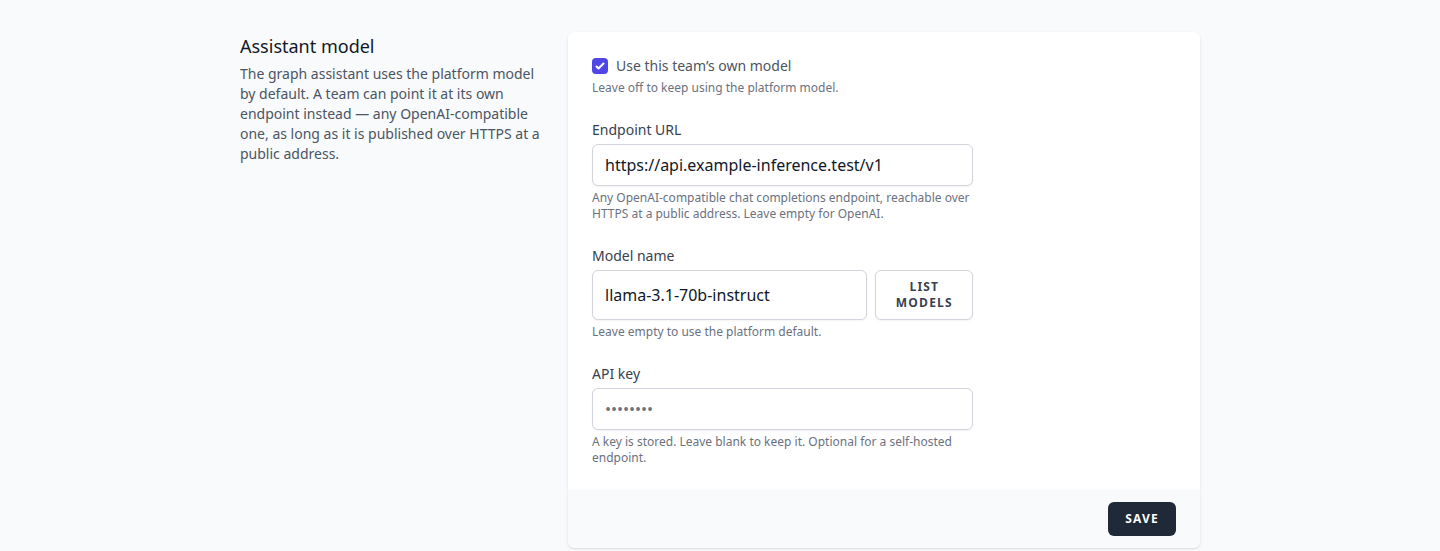
For AI text responses, you can configure:
- Enable custom text model
- Custom base URL
- Custom API key, if required
- Model name, if available in the feature settings
Example base URL format:
http://localhost:11434/v1
The exact URL depends on your provider.
🔌 Transcription endpoint
For audio transcription, you can configure a custom Whisper-compatible endpoint.
This is used by features such as AudioToText and Audio Recording when transcription is enabled.
🔌 Summary model endpoint
Audio Recording can use a separate custom endpoint for AI-generated meeting summaries.
This lets you use one model for transcription and another model for summaries.
👁️ Hidden fields
Custom endpoint fields are hidden by default.
They appear only when the relevant custom endpoint toggle is enabled. This keeps the configuration page cleaner for users who do not need custom providers.
🔐 Security notes
- Do not share API keys with untrusted users.
- Make sure your endpoint is reachable from the environment where YAWBDB runs.
- Use HTTPS for remote endpoints when possible.
- Understand how your provider stores or processes data.
- Test with a small prompt or short audio file first.
🔧 Troubleshooting
🚨 The AI does not respond
Check the base URL, API key, and model name. Also confirm that the endpoint is reachable.
🚨 Transcription fails
Make sure the endpoint is Whisper-compatible and supports the audio file format being sent.
🚨 Summaries fail but transcription works
Check the separate summary model endpoint settings.
🏠 Localhost does not work
localhost` may refer to the container or server itself, use an address reachable from the running service.